Opequon Creek Project Team
The Team
The Opequon Creek Project Team (OCPT) was formed in April 2005 to plan and implement nonpoint source pollution reduction projects in the watershed. Several local, state and federal government agencies are represented at OCPT’s regular meetings, and clean-up and tree planting events have attracted many watershed residents and their families. Opequon Creek Project team quickly has become a dynamic force of progress in the community’s effort to protect and enhance its natural resources.
The Purpose
Our Purpose is to undertake projects that will lead to reduction in pollutants (primarily nutrients, sediment, fecal coliform bacteria, and trash) entering the Opequon Creek and its tributaries in Berkeley and Jefferson Counties, West Virginia.
The Watershed
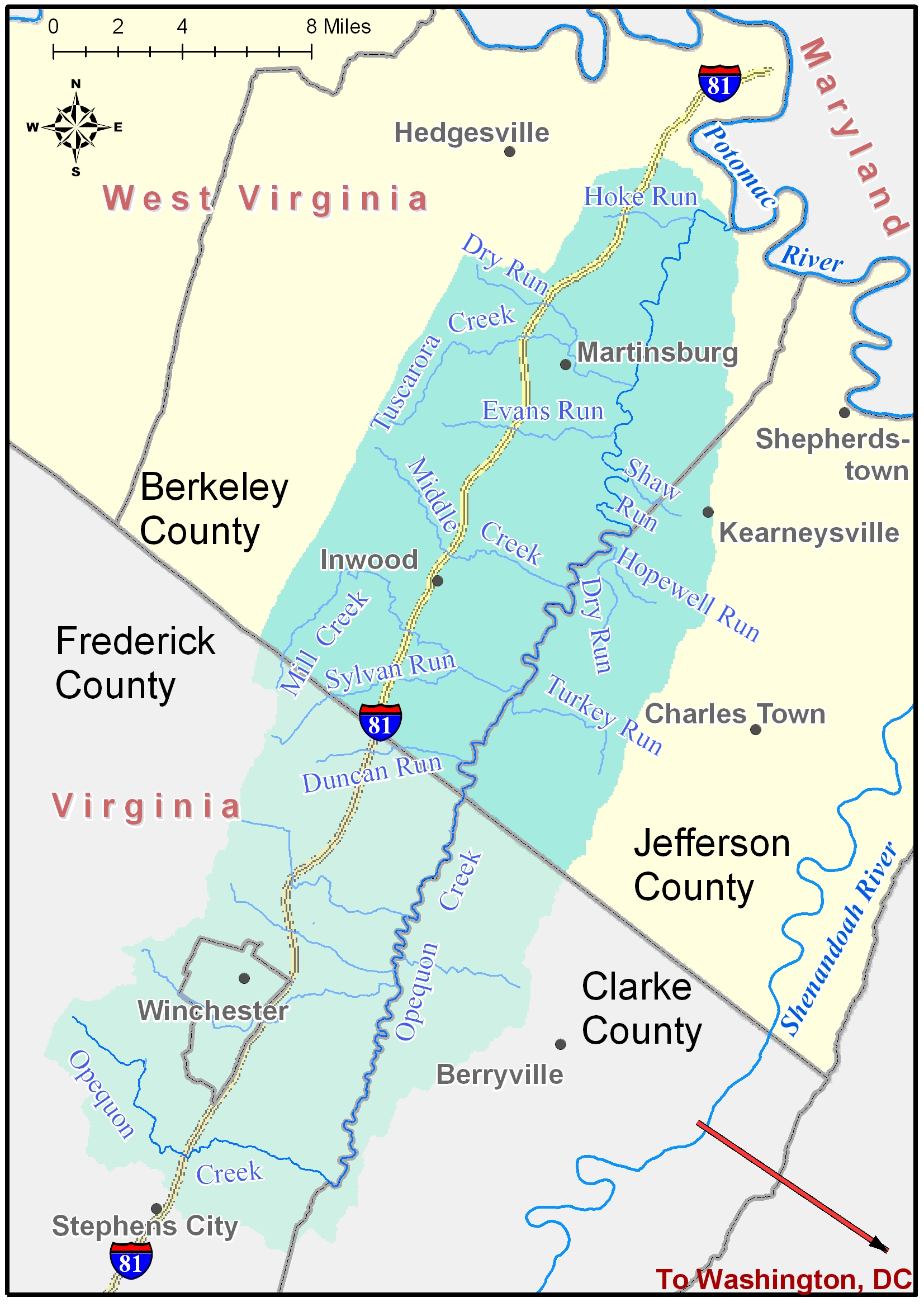
Opequon Creek begins near the town of Opequon in Frederick County, Virginia, and flows east to Clarke County where it bends and flows north into West Virginia and to the Potomac River. The Opequon Creek is part of the Upper Potomac River Watershed, and ultimately the Chesapeake Bay watershed. The lower portion of the Opequon watershed covers an area of about 200 square miles in Berkeley and Jefferson Counties (see watershed map). The West Virginia portion of the Opequon Creek is 34.1 miles long. An analysis of 2003 land use/land cover data for the West Virginia watershed revealed: 51.4% forest, 35.3% agriculture, and 9.5% urban/residential.
The Challenge
The Opequon watershed is of special concern in the Chesapeake Bay cleanup effort due to its high nutrient levels. Nitrogen and phosphorus impairment indices developed in 2004 by the Potomac Tributary Stakeholder Team showed that the Opequon Creek had the highest value for both nitrogen and phosphorus, more than any other West Virginia Potomac sub-watershed. These pollutants likely originate from both point sources (the creek and its tributaries receive effluent from several wastewater treatment plants) and nonpoint sources (agricultural and suburban land uses). Residential development in West Virginia is intense in the eastern panhandle. In 2004, Berkeley and Jefferson Counties had the largest percentages, 34% and 10% respectively, of building permits issued in West Virginia.
You Can Make the Difference!
The Opequon Creek needs your help. If we act now we can reduce contamination in the watershed and preserve the Creek for our enjoyment and that of future generations. Your interest and participation in the Opequon Creek Project Team can make all the difference!
We welcome your suggestions and advice on ways that we can work together to clean-up the Opequon Creek. Below you will see some of the ways we've thought of.
- Tree planting beside streams (also known as riparian buffers)
- Preparing mailings to local landowners
- Cleaning up trash near our local creeks
- Staffing a booth about rain barrels for outreach events
- Monitoring bacteria and/or biological life in local creeks
You can help by lending your time,
talents, and/or local contacts. To get involved and to become a
steward of the Opequon please contact
| Alana Hartman WV DEP Potomac Basin Coordinator (304) 822-7266 |
| © 2007-2008 Opequon Creek
Project Team. Design template by Andreas Viklund |
|
Hosting and Technical Assistance
by:
|